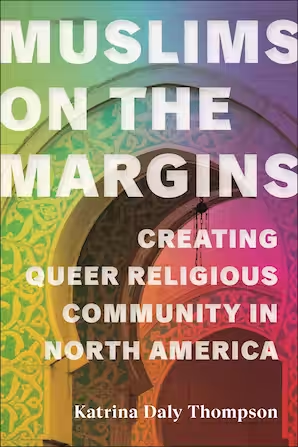
Ben Ale-Ebrahim: Muslims on the Margins is an ethnography of “nonconformist” Muslims living primarily in the United States and Canada, drawing on years of interviews and participant observation within these communities. Could you describe the origins of this project and the collaborations that made it possible?
Katrina Daly Thompson: I’ve been a member of various nonconformist Muslim groups since I converted to Islam in 2009, beginning with the Los Angeles chapter of Muslims for Progressive Values (MPV), then various online groups, and most recently, a Madison-based chapter of El Tawhid Juma Circle (ETCJ) that I co-founded with a friend. Through my participation in these groups, I became interested in how they (we) were using language to create inclusive community, which differed from what I had encountered in more traditional Muslim spaces. Initially, I was interested in language choice (when we used Arabic vs. English). However, through my ethnographic research in several other groups in the US, Canada, and on Facebook, my interests expanded to include how we tell stories, collaborate to translate texts, correct one another when we screw up, and project Muslim nonconformity into the future through what I call discursive futurism. I collaborated with friends and acquaintances who led nonconformist Muslim groups in Los Angeles, San Francisco, Atlanta, Columbus, Chicago, Washington, DC, and Toronto to get permission to visit their groups and do audio recordings of their meetings. Through them, I got to know Muslims in each city, some of whom also took part in interviews.
Ben Ale-Ebrahim: In your analysis, you use a linguistic anthropological approach to discuss how nonconformist Muslims, including many queer and trans Muslims, rework Islamic discursive traditions to be more inclusive of historically marginalized people (9). Could you describe your methodology and what this approach allows us to see about how activists and changemakers engage with tradition in religious communities, particularly Muslim communities in North America?
Katrina Daly Thompson: My methods included participant observation in prayer spaces, discussion groups, Zoom meetings, and online groups. I also conducted individual interviews with Muslims and others participating in those spaces. During in-person and Zoom meetings, I audio-recorded conversations and prayers. Later I transcribed them and analyzed moments where participants were engaged in self-definition or self-reflection about what it meant to them to be part of these groups. In interviews, I asked folks to talk with me about their identities and any qualifiers they might use to describe their or others’ Muslimness. This led to fascinating conversations about identity labels such as progressive, traditional, conservative, mainstream, inclusive, universalist, and others.
Despite their significant contributions to their communities, most folks I spoke with would not consider themselves activists. My focus on their discourse allows us to see how ordinary religious people—not just scholars and activists—are engaged with tradition in worship spaces and religion-focused conversations and how they imagine and create new traditions through interaction.
Ben Ale-Ebrahim: In chapter 3, you discuss gender inclusive prayer spaces, where people of all genders come together to pray salah (ritual prayers) in one space, side by side. I was struck by the way your interlocutors described the experience of praying in these spaces as a two-part process of unlearning old ways of practicing Islam and learning new ones, similar to the process of unlearning a trans friend’s dead name and learning to use their new pronouns (72). What do you hope other ethnographers can learn about performance and performativity from this chapter?
Katrina Daly Thompson: In that chapter, I was influenced by Saba Mahmood’s work on performativity. But her focus was on individual women, whereas many of my participants talked about how the experience of performing prayer in community led them to develop nonconformist understandings about gender expansive prayer, women’s prayer leadership, the need for hijab, and other related topics. In other words, through practicing Islam in nonconformist ways, Muslims do not merely perform nonconformity and inclusion; they cultivate it. Through my research, I discovered that there is an intercorporeal element to performance and performativity that ethnographers must consider to understand how individuals engage with those who embody differences and how they learn to enact inclusivity. I hope that my approach inspires other ethnographers to adopt a similar perspective and recognize the importance of attending to intercorporeal elements when studying performance and performativity.
Ben Ale-Ebrahim: In chapter 4, analyzing queer Muslim talk, you describe how coming out as Muslim in queer spaces functions to disrupt secular homonormativity, making other queers uncomfortable through overt expressions of a religious identity (105). What are your thoughts on how queer discomfort with expressions of Muslimness within queer spaces relates to histories of racialized Islamophobia in the US and Canada?
Katrina Daly Thompson: Islamophobia was not a significant topic of discussion in most of my research, with the exception of one example I discussed in that chapter. However, I view queer Islamophobia as a continuation of the racialized Islamophobia that is unfortunately prevalent in many parts of the world where Muslims are in the minority, including the US and Canada. In queer spaces, the issue becomes even more complex due to the oppression that many queer and trans individuals have faced within various religious traditions. This has led some to assume that religion and queerness are incompatible, and some queer Muslims have even internalized this Islamophobic belief.
Ben Ale-Ebrahim: When other anthropologists have written about LGBTQ+ Muslim experiences, they have often drawn on an analytical paradigm of “incommensurability” (Boellstorff 2007) or “contradictory identities” (Peumans 2017) — the common perception that it is very difficult, if not impossible, to be both Muslim and LGBTQ+ at the same time. What are your thoughts on how this project expands the conversation about the relationship between LGBTQ+ and Muslim identities?
Katrina Daly Thompson: Undoubtedly, being both Muslim and queer or trans can be a challenging experience, not only due to Muslim homophobia and queer Islamophobia but also because of the perception that these identities cannot coexist. However, the nonconformist Muslim groups I studied provide participants with an opportunity to realize that these identities are not contradictory, but rather—in inclusive spaces—celebrated and embraced. Muslims on the Margins draws upon the concept of “indexical disjuncture” proposed by queer linguist Rusty Barrett to demonstrate how queer Muslims and those in solidarity with them intentionally bring together, discursively or visually, aspects of their Muslimness and their queerness to disrupt others’ understandings of both.
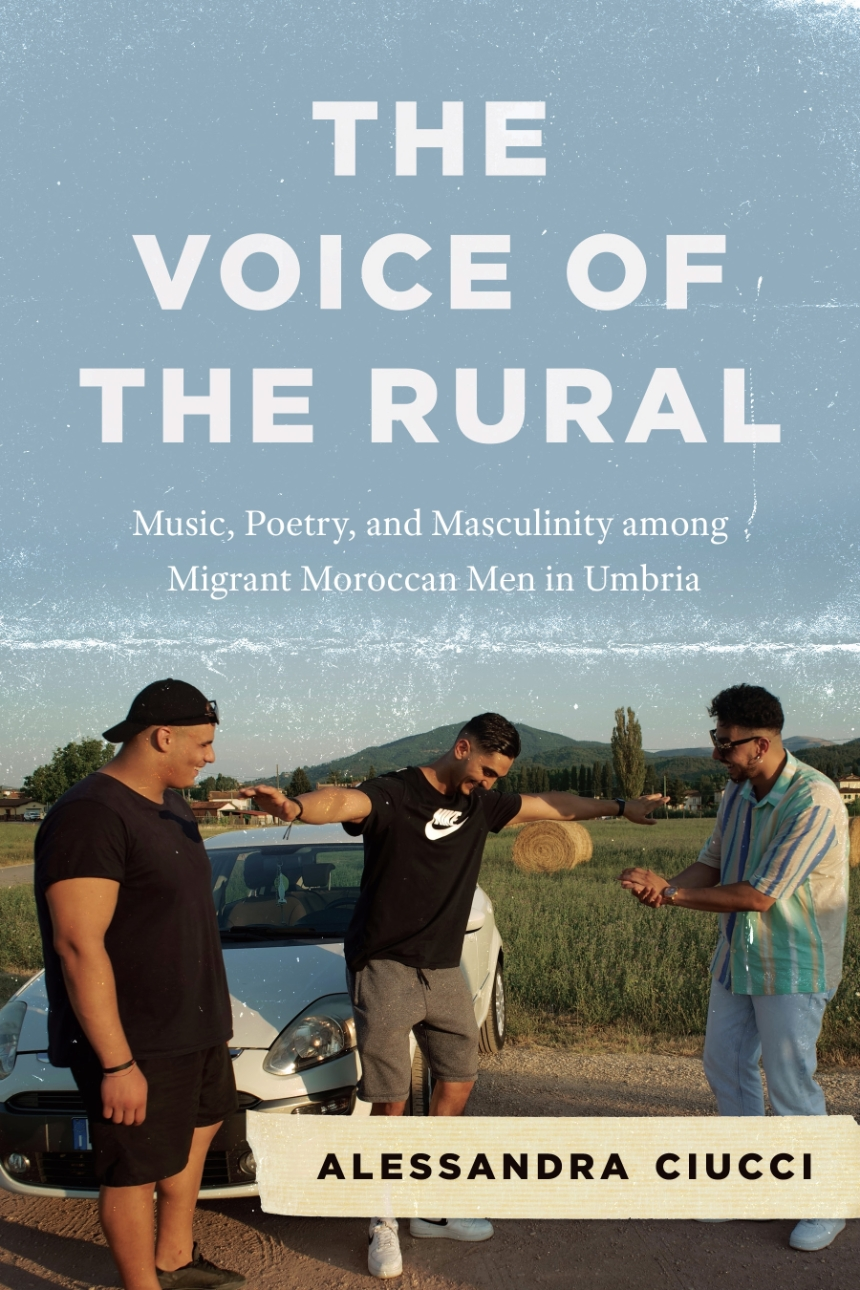
Nicco La Mattina: In The Voice of the Rural, by attending to competing aesthetic discourses, the circulation of migratory experience, enactments of gendered morality, and the tenacity of Moroccan rurality (l-ʿarubiya) in central Italy you center the notion of “voice” (ṣawt). How do timbral “voice” and social “voice” relate to each other in your work and among your Moroccan interlocutors?
Alessandra Ciucci: First of all, thank you for your interest in my book and for your wonderful questions!
Let me begin with saying that it was the vocal timbre of the Moroccan female performers (shikhat) that I worked with in preparation of my dissertation that first caught my ears; performers that, upon listening to their recordings, my mother had curiously enough identified as Neapolitans. It was during my fieldwork that I started to noticing what that particular timbral voice meant for those who listened to one of the musicopoetic genre in question, ‘aiṭa, and how, more often than not, they described it by analogy to other senses (smell and taste in particular). A number of scholars have pointed out how, although we hear timbre, we have no language to describe it; but for me, musicians’ tropes and metaphors about timbre, demonstrate the way in which they theorize it. So, the moment that my interlocutors begun discussing timbral voice in reference to a particular region in Morocco and, more compellingly, to the soil of the region, I realized I had to take such connection seriously. The association between a timbral voice with a particular notion of the rural or the countryside (l-ʿarubiya), with the experience of the environment, and with the way in which people define their sense of selves became key to my research.
The relation between timbral voice and social voice is thus at the essence of my book and, more in particular, in the role it plays in the construction of l-ʿarubi (rural person or someone whose origins cannot be disentangled from the territory of the Atlantic plains and plateaus) during the French Protectorate (1912-56) and after Independence. The timbral voice I discuss has historically been at the core of the sonic difference of l-ʿarubi. Timbral voice and social voice are thus deeply entangled in my study, precisely because the voice I discuss marks origin, class, race, ethnicity, mentality and level of civilization. My Moroccan interlocutors continue to be described and judged by a voice whose timbre is thought to embody excess, perceived as rough and, in turn, linked to the uncivilized. And yet, my interlocutors reclaim that voice and its “rough” (ḥərsh) timbre; unwilling to conform to the standards laid out for them in both Morocco and Italy.
Nicco La Mattina:What is the counteraesthetics of roughness/coarseness (ḥərsh) in Moroccan rurality with respect to moral discourse, moral struggle, and the emotional experiences of migrant Moroccan men?
Alessandra Ciucci: As I have anticipated in my first response, the roughness I discuss, heard by the colonizers with a sort of “acoustic disgust,” became deeply entangled with non-humans. Once described and inscribed into writing, the perception of roughness as vulgar, affected the vernacular language associated with the countryside, and the musical traditions of l-ʿarubiya. Voice, therefore, became a crucial arena where taste and morality converged, particularly in the case of the shikhat, whose vocality indexed a sensual excess enmeshed in Orientalist tropes. The amorality of the shikhat, and of those who listened to their voices,was entrenched in how colonial perceived a rough vocal timbre. This perception did not end with Independence and this is why I described the process of the re-valorization of ʿaita and the shikhat as a moral struggle, an attempt for Moroccan intellectuals to validate—as men—their moral worth.
See, the voice of the rural and its rough timbre is significantly entangled with the construction of the ʿarubi, but also with what it means to be a real man (rəjal) defined in relation to courage, stoicism, sense of duty toward the family and the community, generosity, the respect a man has earned, his physical and moral strength, as well as his virility. These critical values are at risk in the face of migration, the risk of “becoming Italian,” the potential loss of fundamental mores and values, but also in the face of racism, stigmatization and daily humiliations. In this context, the counteraesthetics of roughness sonically challenge dominant structures of power in Italy, allowing migrant Moroccan men to reconstruct a sense of the rural and manhood that is muted in Italy.
Nicco La Mattina:Your earlier writings, recently collected in Arabic translation (The Voices of ʿAiṭa), centered upon the woman-voiced musicopoetic genre ʿaiṭa as it is performed, listened to, and talked about in Morocco. How did you come, in The Voice of the Rural, to attend to the man-voiced genre ʿabidat r-rma and focus on how both genres are listened to by and circulate among Moroccan men inItaly? What role, more broadly, did the concept of genre play in this transition?
Alessandra Ciucci: In Morocco, ʿaiṭa and ʿabidat r-rma are considered as two interrelated genres, both deeply embedded in the notion of l-‘arubiya. In many ways, to begin with ʿaiṭa and continue with ʿabidat r-rma was an inevitable and natural step for me, particularly since both genres are part of the listening repertory of migrants. Although closely related, the key distinction between ‘aiṭa and ‘abidat r-rma is in the voice. As the musicians unequivocally point out, while ‘aiṭa needs the voice of a woman (ṣawt mra), ‘abidat r-rma needs the voice of men (ṣawt r-rjal). In this sense, while the concept of genre has indeed play an important role in my work, my choices were made first in reference to music practices embodying l-‘arubiya in sound, and then in reference to the listening practices of my interlocutors. I must also say that my interest in ʿabidat r-rma started as I was finishing my dissertation on ʿaiṭa. I had participated in a festival of ʿabidat r-rma in the city of Khouribga and I was blown away by this genre. But, more than anything, it was the title of a song in an old audio cassette, “l-‘arubi fi roma” (the “‘arubi in Rome,” the city in which I was born and grew up), that truly sparked my attention. That is, in many ways, when the transition started.
Nicco La Mattina:Throughout your work, in addition to in-person performance, you have attended to the role of sound technologies, such as audiocassettes and online videos. What is the role of (mass-)mediation in your work and in the voicing of Moroccan rurality in the Moroccan and Italian countrysides?
Alessandra Ciucci: Despite having attended lots of in-person performances in Morocco, I chose to center on mediated performances available online since they reflect the ways in which migrants engage with music when traditional contexts of performance are not available to them, as in the case of Italy. I understand these digitized performancesas another mode of circulation with which Moroccans continue to engage in a meaningful way and, in turn, as effective tools for an analysis anchored in ethnography.
My interest in sound technology also draws from the fact that commercial recordings were fundamental for the circulation of the voice of the rural, a voice which in the past could not be heard on radio or television. While the gramophone and the 78-rpm recordings had remained elitist goods, and the 33-rpm records and the more popular 45s never truly acquired the status of a mass product, audiocassettes became particularly popular. Cheap and easy to use, audiocassettes allowed one to tape one’s favorite songs and for anyone to create a preferred collection of music. In this sense, audiocassettes allowed for the voice of the rural to spread.
Nicco La Mattina:You distinguish two views of the Mediterranean: European views of the sea connecting and Arabic views of the sea separating two shores. As you write, Moroccan migrants in Italy both voice and reconnect across this barrier (ḥājiz) through music. How has the Mediterranean figured in and shaped your extensive fieldwork conducted in both Morocco and Italy, with performers and audiences?
Alessandra Ciucci: In the past decades, the study of music and sound around the Mediterranean has produced seminal works seeking to reconsider historical and contemporary forms of mobility and exchange; to imagine a different cartography that pays attention to the many possibilities in thinking in sound aroundthe Mediterranean. Thus, in engaging with recent debates that seek to problematize the idea of the Mediterranean as a site of flow, mobility and exchange, and in questioning a central narrative of the region as producing music expressing “shared traditions,” my engagement with the Mediterranean has been to call attention to another experience of the sea, to attend to the earache and the imbalance which may be caused by downplaying the reality of the Mediterranean as a barrier between two shores, and to inquire into the very idea of what it means to listen in and from the Mediterranean. I have been concerned with making audible an alternative experience of the sea, with telling another story in a conglomerate of stories that I believe make up the Mediterranean. In this context, the voice of the rural has played a key role, providing a basis for reflecting on the complex and asymmetrical connections between regions, border modalities of power, and what I understand as a critical undercurrent transforming the contemporary Mediterranean.
Joseph Wilson: The combination of legal discourse analysis and technology studies in this book is a fascinating mix. How Machines Came to Speak examines the legal definition of speech (as part of the concept of free speech) and how it morphed over the years as new technologies changed the way Americans communicated. How did you first come up with this topic? Did you come at it from a legal angle or from an STS angle?
Jennifer Petersen: I came to the book from the history of media technologies (informed by STS) and communication history, and a set of interests—or perhaps a puzzlement—about the status and authority of law. In particular, I was interested in free speech law as a site where debates about rationality and emotion, ideas and action (for example, when does speech become a threat or harm; how is money considered speech) take place, with social and political consequences.
In graduate school, I had written a paper looking at how judges were determining whether and how the First Amendment applied to new media – at the time, software, URLs and hyperlinks. I was fascinated by the way the judges were theorizing communication in these cases. The paper left me with a lot of unanswered questions, so when I finished my first book, these nagging questions returned. When I thought about the scholarship I would need to read to work through these questions, I was all in.
Joseph Wilson: You write that in the 20th century written speech (newspapers, books, pamphlets) was often privileged over other modes of ‘speech’ (film, radio, flag-burning) because of its association with rationality, civilization, masculinity and the ‘world of the mind’. With the rise of new visual/aural media like podcasts, TikTok videos, or even video games, do you think these Enlightement-era binaries are starting to break down? Is the written word still considered the archetypical medium of speech?
Jennifer Petersen: I do think the binaries that were in place at the beginning of the century have eroded in some ways. This is perhaps most evident in examples of expressive conduct. In the early 20th century, physical activities and non-verbal expression were clearly physical conduct. By the mid- to late-20th century, it was possible to consider many forms of physical conduct – from flag burning to sit-ins and other forms of silent protest, like Colin Kaepernick’s silent protest –as expressive, even when they do not clearly translate into words, or a verbal message. And I do think that pictorial and visual media will continue to erode this distinction.
However, in many ways the written word is very much the archetype of speech in legal discussions of the First Amendment. In determining whether new or controversial cases are speech, judges and justices often turn to words and writing. For example, when arguing that naked dancing was a form of speech (albeit a putatively lesser one), one of the justices anchored his reasoning in the assertion that dancing is like writing with the body. Given this, it is no coincidence that the current challenge to anti-discrimination laws in Colorado is being brought for a business that is proposing to build websites and wants to exclude same-sex customers. If you remember, there was a similar case a few years ago involving a baker who refused to make wedding cakes for same-sex customers. Cakes were less evidently expressive (though there was a lot of discussion of the fact that bakers use icing to write messages on cakes!) than websites are. I think the current case has probably been engineered to appeal explicitly to the Court’s bias toward writing.
Joseph Wilson: You point out that during the radio era it was legally understood that the speech one heard on the radio did not necessarily represent the views of the radio announcer, but was instead the work of a team of people: station owners, distributors, advertisers, announcers, and so on. This reminds me of Goffman’s distinction between animator, author, and principal. Do you think there is a danger that this kind of distribution of responsibility can be used as a defense against the consequences of truly offensive or dangerous speech?
Jennifer Petersen: The question of distributed speech is one that really interests me. Your last question asked about erosion of older binaries. One of the questions that came out of this book for me was about how the experience of algorithmic media – from Tik Tok to bots—might erode some of the dualisms around speech and subjectivity or personhood. I wondered whether our current experiences might re-shape our understandings of speech, so that in the future the idea of an autonomous speaking subject is less central. One of the ways in which we currently experience algorithmic mediation is as a change in the structure of speech or authorship. In many such contexts, either 1.) what we say is understood not to be entirely of our own making; or 2.) complex systems designed and prompted by people produce outcomes that are not direct expressions of their thoughts, beliefs, knowledge or intention (for example, ChatGPT). Put differently, in many algorithmically mediated contexts, we understand ourselves to be speaking with or through complex sociotechnical systems; the chains of intentionality and agency behind any expression are distributed rather than direct. I am very curious about how this experience will shape the next generations of judges’ and justices’ assumptions about what speech is and who (or what) can speak.
This has some attractive political and ethical implications for how we might understand ourselves and constitute community. In some ways, when we decenter ourselves and our intentions, our sphere of responsibility may expand. For example, if what makes my words racist or damaging is not my thoughts or intentions but their effects in the world, my responsibility for those words is expanded. I think that many of my students are coming to express this sense of ethics and accountability.
Also, it’s the conception of speech as the direct expression of an individual’s ideas and beliefs does not bring with it a lot of accountability. We are held legally accountable only for expression that harms reputation (defamation), that incites or is very likely to incite criminal actions, and that poses a “true threat” (such as, burning a cross on someone’s lawn as a treat of racial or religious violence).
Joseph Wilson: There has also been a lot of criticism recently (a so-called techlash) about data collection, privacy policies, and the ability for social media companies to manipulate what people understand to be the truth, much of which is currently protected under freedom of speech laws. This is a version of what you call a ‘posthuman conception of speech’. Are we due for a (legal) correction to this broad understanding of speech, one that rehumanizes speech as the realm of only humans?
Jennifer Petersen: When I talk about the posthuman conception of speech, I’m looking at instances where lawyers and judges reason about speech without reference or regard to speakers. When the courts say that the flow of information is speech, or that particular artifacts are speech, and attempt to analyze speech without reference to social dynamics or agents involved, they are engaging in what I call a posthuman approach to speech. It is one that does not require persons.
Interestingly, in the examples you mention in this question, tech companies have been drawing on classic liberal humanist arguments. For instance, Google’s search results have been classified as speech because they represent the ideas and opinions of Google employees and/or the company. In practice, the company becomes endowed with protections crafted for persons – in particular, political persons, in effect granting these companies more political and legal capacities. These companies, in sum, use arguments about civil liberties in order to gain market and legal leverage.
Yet, I don’t think saying that speech rights are only ever for natural persons, or individuals—or rehumanizing speech –will answer these problems. There are reasons to think that organizations, even corporations, might play some role in our public sphere, and expressive and political landscape. In fact, part of the problem I see is that speech is understood too narrowly in terms of a classic, liberal vision of persons. It is this close articulation of speech to a form of agency associated with natural persons that allows corporations to game the system.
I think, rather, that a less dichotomous approach to speech and agency may be in order. The examples of distributed, algorithmically-mediated speech noted above may be able to help us think more productively about expression. They may help us dis-articulate speech from the minds of discrete subjects, and help us think through expression as having a variable relation to things like the opinions, intentionality, conscience, and will of persons.
We need, I think, a broader and variegated conception of what it means to speak today – a broader ecology of means and forms of speaking as well as of different types of speakers. And we need ways of adapting the law to these different forms rather than an all or nothing logic. I think this would be hard. It would bring its own problems. And it, too, would be open to opportunism. But the opportunities would be fewer without the current winner takes all stakes.
Joseph Wilson: In recent years, the concept of free speech has drifted from being a supposedly typical left-wing issue favored by social democrats, towards the right, where it is often used as a defence against accusations of political incorrectness. How does this political reframing fit into your argument that speech is a ‘historically contingent’ concept?
Jennifer Petersen: I think that when we think we know what speech is – and that this is always what it has been – it is easy to think that what is going on right now is about “the left” abandoning speech or “the right” taking up the rhetoric if not the actual substance of free speech (the right, after all, is busy banning books and dictating curricula, both textbook examples of censorship).
To some extent, I think that this framing can act as something of a red herring, especially for the types of legal opportunism outlined above, in which companies use the First Amendment to avoid regulation as well as to enhance their standing as persons, or subjects before the law. In many of the key legal battles today, the expression being fought over does not look like a dissenter on a soap box or sound truck. Rather, these cases often center on categorizing economic transactions, services, and products as expression in order to gain favorable regulatory outcomes. The political and social stakes of cases like these are substantively different from the debates over whether sit ins are a form of expression—yet, when courts support these claims, they often do so in the names of political freedom and civil liberties.
I think that a large part of what enables these opportunistic uses of the First Amendment is the way speech as a legal category has transformed over time without serious attention and reflection. When we engage in discussions of whether free speech is a left or right issue, I think we lose sight of the pressing issues around technology and opportunism outlined above. To me, this is an essential political and theoretical misstep. Looking instead at the underlying definitions of speech can help to highlight what exactly is at the heart of free speech disputes. It can also provide new arguments and insights for charting a future as technologies again change what it means to speak.
Ilana Gershon: What was the moment that you realized that you had to write a book on what role diversity is now supposed to play in liberal arts education?
Bonnie Urciuoli: It was some years after I started the actual research which itself started by accident. In the early 1990s, I had begun my teaching career at a small, expensive, and quite white liberal arts college while finishing my first book (Exposing Prejudice) about New York Puerto Rican experiences of race, class, and language. I had several students who could have been from the families and neighborhoods of the people I worked with for that book, and we talked sometimes about their take on life at the college. Then I heard about a faculty member telling incoming bilingual students in their summer course for the Higher Education Opportunity Program that their writing was poor because they thought in Spanish. As I got to know these students, we started talking about being judged in racialized ways. These conversations led to interviews about coming to the college as Puerto Rican from the Bronx or Dominican from the Heights and then being reclassified – and learning to imagine oneself – as multicultural (diverse was not yet a widespread term) and as Hispanic or Latino/a (Latinx not yet a term at all). My first attempts to write this up were unsatisfying. Then I realized that while multicultural affairs administrators (in the student life office) tried to recognize and address issues faced by students of color, the offices of institutional advancement and admissions saw students of color as a resource for promoting the college and recruiting white students. This was the late 1990s, when the college branding and marketing industry was taking off. In conversations with my dear late colleague Henry Rutz, conversations that became for me an extended informal tutorial on the commodification of higher education, I came to see how notions of “diversity” had come to index market positioning for the promotion of liberal arts education. That’s probably when I understood that the core issue of the book, which I framed using Michael Silverstein’s semiotic approach, would be how elite liberal arts institutions work images of and stories about student ‘diversity’ into their marketing, part of a larger process targeting prospective students, parents, and donors who are overwhelmingly white.
IG: I am struck how much this neoliberal notion of diversity heavily depends on a particular understanding of race as the ur-example. How does it happen that race seems to be the template shaping what diversity becomes in the hands of higher education institutions?
BU: What I call neoliberal diversity derives from an understanding of race as an inherent characteristic of person that can be counted and visualized. It builds on and departs from older notions of race. Race, as the construction evolved over centuries of chattel slavery and colonizers’ appropriation of inhabitants’ land, resources, and labor, was construed as natural, inherited, hierarchic, and physically manifest. Race in the U.S. has been bureaucratized since 1790 as countable census units. It is now most widely counted using some form of the Office of Management and Budget (OMB or ‘affirmative action’) categories Black/African American, Hispanic/Latino, Asian/Pacific Islander, Native American, White. In the 1980s, the general term for non-white in undergraduate student life (and curricula) was multicultural(ism), emphasizing positive elements of identity and history. The neoliberal angle, promoted in the 1990s by diversity trainers to obscure associations with group identity and social justice, replaced use of affirmative action and multiculturalism with diversity, signifying valued resources brought to work by individual workers and obscuring historically embedded hierarchy. As neoliberal notions of diversity moved from the corporate world into higher education, they were taken up by offices of admission and college marketers playing to prospective white students, parents, and trustees with the message that diversity, in the form of students of color, added value to (white) students’ education. College marketers may talk about “all kinds of diversity” but they need students who look like they fit those OMB categories to count and show pictures of and tell inspiring stories about on the website.
Ilana Gershon: What would you want students of color at other colleges to know about how higher education structures diversity?
Bonnie Urciuoli: As will be news to no one, the primary social function of higher education, what it actually does, is not particularly student centered. So it will also be no surprise that higher education institutions use diversity in ways that benefit their own interests (as Sara Ahmed points out in On Being Included), just as they use any term or notion (community, changemaking, find your passion – to pick a few at random from college websites) meant to shape how they are perceived. Actual education and student welfare do not top this list. Given the market ordering of higher education (like any institution and organization) under conditions of contemporary capitalism, the primary function of terms favored by marketers is going to be promotional. But linguistic/semantic ideologies direct people to expect words to have ‘real’ (fixed, universal) meaning. One hears institutional talk about valuing diversity, and one might legitimately take value and diversity at (what one assumes to be) face value. I’d like all students anywhere to understand that point. I’d particularly like students of color anywhere to be suspicious as hell about the motives of higher education administrators, marketers, or for that matter faculty who forward institutional interests or their own interests through rhetoric that plays on student identities: they are unlikely to have students’ best interests at heart.
Ilana Gershon: Why do fraternities keep holding parties with questionable themes? What is it about whiteness in the context of this neoliberal institution with its particular version of diversity that fraternities are in relationship to in these parties?
Bonnie Urciuoli: The ‘Ethnic Night’ theme party (a racialized ethnicity) that I wrote about in chapter 5 got immediate stiff blowback and, as far as I know, it was the last one that fraternity gave. Why did they give it in the first place? Since I didn’t interview the members involved, I can only go by what I heard: they had given this theme party for years, they served food and drink and played music identified with that ethnic group, and attendees dressed as members of that ethnic group. (So far as I know, this did not involve blackface, which involves dynamics beyond what I cover here.) The question remains, when students do throw such parties, why don’t they think about the racialized ethnic stereotype in relation to whiteness? My answer, condensed from that chapter, is that most students at privileged schools, especially those who are socially unmarked (what the group involved regards as a typical or modal social identity, here middle-class white), are likely to see the sphere of the social as the sphere of fun (as Chaise LaDousa has masterfully analyzed in House Signs and Collegiate Fun). Fraternity life provides that sphere as autonomous and separate from ‘official’ college control, enhanced by alcohol and enacted through transgressive play. Unmarked people, students or not, are also likely to see racial issues in terms of personal intent (certainly not structure), and if no one ‘intended’ harm then no harm was done; hence participants disassociate theme parties from racism. They also dissociate them from any notion of diversity associated with school policy which has no place in the world of student fun.
The chapter also looks at a Bros and Hoes party given by a different fraternity. The Ethnic Night party generated a strong sense of moral outrage among faculty and students; the Bros and Hoes party provoked some but much less reaction. The difference, I suspect, lies in the dynamics of play with racial markedness versus with gender markedness. In Ethnic Night (and other race/ethnic themed) parties, unmarked students play at being marked. In Bros and Hoes parties, Hoes, marked relative to Bros, are performed by actual women exaggerating (often transgressively) the terms of that markedness. Women are thus participants (perhaps even party planners), whereas race/ethnic themed parties do not (usually) include marked participants playing stereotyped versions of themselves. One is tempted to see all this in terms of student morality, but it makes more analytic sense to consider what is indexed by the difference in markedness dynamics. White and non-white students are disconnected in ways that male and female students are not. The ‘fun’ stance grows from a secure social milieu in which people can choose who they want to be with, women along with men, though the footing is not altogether equal. Being an insider ‘playing’ with notions of race, class, ethnicity, or sex means not taking it seriously or as subject to critique. The critical stance grows from taking an outside perspective.
IG: What work do workshops do as the go-to genre for how institutions choose to address diversity in higher education?
BU: What I can talk about here are the diversity hiring workshops that the Dean of Faculty office required chairs of departments hiring new faculty to attend. Such workshops keep attention firmly disconnected from anything resembling actual history or group formation. They reinforce administrative authority and notions of diversity as beneficial to the institution. Institutions prefer to hire workshops from agencies that their peer institutions use (as agency websites make clear) rather than treat their own faculty as a source of expertise. A workshop’s success (again, as their websites tell you) is measured by outcome, for example, how many diversity hires the school makes after the workshop is given. Workshop messaging to faculty emphasizes how diversity hires enrich their departments, provide role models for students of color, and enhance institutional ‘excellence’: therefore, faculty must proceed with hires as directed by the workshop. The neoliberal message cannot be missed: diversity provides added value, and the more you hire, the more value you add. As to conditions and problems likely to be faced by faculty of color, or how their careers might be affected by the institution or the department – none of that comes up. Workshops also use double addressivity: their overt addressees are faculty; their covert addressees are administrators. They tell faculty what to do and they tell administrators that they recognize that the real problem is faculty who don’t know what to do; in other words, they are helping administrators discipline problem faculty. Above all, such workshops and the experts who run them base their expertise on not bringing historical/structural inequality into play in any systematic way. Their expertise is based on being able to solve problems by fixing what individuals (those problem faculty) do, not by addressing the ways in which inequalities are part of the institution. They are certainly not going to challenge the ways that institutions benefit from the same neoliberalized notions and practices that sustain their market position (and keep the workshop agencies in business).
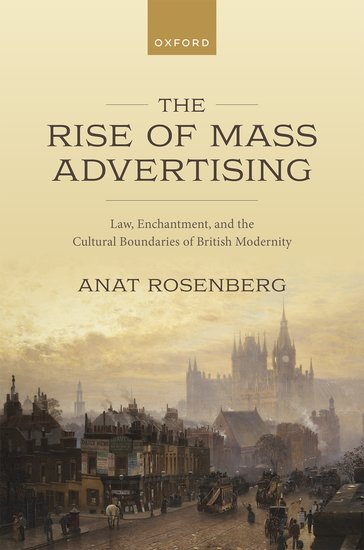
Astrid Van den Bossche: One striking focus of your book is the presence and treatment—legally, culturally, and scholarly—of enchantment as a recurring, and potentially structuring, market experience. As you note, there is much debate on the (dis)enchanted status of modern life, but what led you to this focus in a history of mass advertising in Britain?
Anat Rosenberg: In truth, I did not come with this question to the research. Only after delving into the sources I realized that the tension between disenchantment and enchantment was central to the history of advertising, to ways of loving and hating it, and to its legal ordering.
When you start thinking about it, connecting advertising and enchantment might seem obvious, because there is such a huge body of literature that does just that, both in the critical tradition (think about Barthes, Baudrillard, Raymond Williams and others), and recently with more interest in the possibility that enchantment is not a danger or manipulation, but a form of agency (Jane Bennett for example, David Morgan and others). And yet I saw three gaps in this literature. First, there is almost nothing about enchantment by advertising in the first era of mass advertising in Britain, around 1840 -1914 – it has simply not been a theme for most historians of the period. Second, what you can glean from existing histories is dominated by material from the producer-end: interpretive studies of adverts and archives of businesses and advertising agencies. Additional scholarship is philosophical in nature, the Frankfurt School for example. Finally, there was nothing about the legal treatment of enchantment.
So, my opening chapter responds to the first two gaps with a study of reception sources for advertising. I have used everything I could find: testimonies of consumers in court suits against advertisers, comments in the press, autobiographies and diaries, fiction, works of art, albums and scrapbooks. I trace what readers of adverts were looking for, how they imagined the mysteries and adventures of their world by inhabiting environments of mass advertising. Then, the rest of the book examines how law was mobilized to respond to mass advertising on the level of social ordering, and particularly how responses disavowed enchantment. That is why I argue that there was a normative project of disenchantment. While disenchantment was not a historical reality – here I side with revisionist historians, it was much more than a wavering ideology. It was an active enterprise made up of multiple legal investments across British culture, which gathered momentum despite of – or because – enchantment was such a constitutive experience of the capitalist economy.
Astrid Van den Bossche: By looking at gambling and indecency, Chapter 6 in particular pushes against the limits of discourses of modern disenchantments, and points to the consequently sketchy theorisation of enchantment. What are your key takeaways for the historical study and conceptualisation of enchantment?
Anat Rosenberg: The censorship of gambling and indecent adverts was my last hope for a significant legal conceptualization of enchantment. Until that point, I encountered disavowals. Almost everywhere, debates about advertising gravitated towards its legitimation and criticism within rationalist paradigms. I then expected debates about gambling and indecency to be the exception to the rule, because they started out by worrying about consumers’ non-rational responses to mass culture. The theory of gambling highlighted gamblers’ defiance of reason and quasi-mystical views. The theory of indecency placed primacy on the power of print to interact with receptive minds, ignite desires, and draw affective responses. However, the potential of theories of enchantment to reconceive advertising was checked, and they ended on a weak and even banal note. The legal logic and practice of censorship in fact shielded the better part of advertising from a developed discussion of enchanting appeals, and so censorious theories ultimately affirmed that adverting was compatible with a disenchanted culture.
This limited conceptualization of enchantment was not a failure of understanding, or a historical accident. It reflected a cultural commitment to modernity-as-disenchantment, which relied on law to make itself present in everyday life. In other words, what might seem sketchy or inadequate was in fact a serious effort to insist that capitalism was a disenchanting force and that modernity was a victory of reason, while a messier possibility was looming large.
From a historical perspective we could ask whether this effort was successful. The answer is complex. Despite its analytic weakness, modernity-as-disenchantment became common sense. The host of perspectives it involved in terms of the rationalities of cultural fields and the dispassionate mentality of economic life itself, were and remain dominant. Yet, all this did not preclude enchantment, it just deprived it of normative conceptual languages, which had ironic outcomes. Because enchantment was disavowed, advertising was treated like a failure: it was described as biased information, vulgar aesthetic, knowledge corrupted by exaggeration. Such attacks unwittingly liberated advertisers from rationalist inhibitions – since they were failing anyway, and finally drove professional advertisers to adopt a theory that celebrated enchantment. This theory was attractive because law had little to say about it. Professionals branded themselves as masters of the nonrational mind, a myth that has held incredible sway.
Astrid Van den Bossche: This leads us, in fact, to the other main argument of the book, which is that the boundaries between advertising and other cultural fields such as the press, the arts, and the sciences, were continuously tested, contested, and redrawn. As you point to above on the celebration of enchantment as the advertiser’s craft, advertising as we know it is the result of this boundary work. Reversely, we might imagine that advertising had a hand in shaping the cultural fields that sought to distance themselves from it. How far could we go with this argument, in your view?
Anat Rosenberg: Pretty far, I think. Advertising developed by defying and testing cultural boundaries, as it traded and trod on the cultural authority of other fields. Legal boundary work dealt with these challenges, and created differentiations. In this process advertising functioned as a cultural scapegoat, which carried the burden of commercial corruption for other fields. The dangers of the profit motive were attributed to advertisers, who were associated with concepts of bias, vulgarity, or exaggeration, while other fields could claim to represent higher ideals of aesthetic appreciation, objective knowledge, or impartial information. Of course, no field was free from market pressures at this point, but advertising salvaged them because in the ongoing comparison they fared better.
So, the broad argument of the book is that advertising energized an entire culture to examine and explain the terms on which it lived. Its history should not be examined only from the perspective of consumption or commerce – it had a world-generating power across fields in terms of aesthetics, epistemology, and ontology.
Astrid Van den Bossche: Drawing on legal archives, from legal treatises to case reports, has allowed you to unpack the norming and legitimisation of advertising practices. What advice do you have for those who might be less familiar with these resources?
Anat Rosenberg: Law is too important to leave only to lawyers, don’t be afraid to delve into these sources. We have not seen book-length histories of advertising that work with law seriously (as far as I know), which is unfortunate because it has limited our understanding of the its history. Without the legal angle, it is hard to see the commonalities and broad implications of seemingly different areas in which advertising was being contested, challenged and shaped, from art through journalism to medicine and more.
To integrate law into our sources of cultural analysis is more straight forward than might first appear. After all, it consists of very human efforts to formulate social meanings, resolve cultural dilemmas, and frame normativity. It involves not only legislators and courts, and not only trained legal professionals but also local organizations, practices, and material environments that are part of daily pursuits, market relationships, and substate structures. Multiple actors create, adapt, and perform normativity in these environments, and attempt to formalize it within their distinct constraints and opportunities. From this perspective, law is emergent and dispersed, and often non-lawyers will have unique insight. What is more, from this perspective most resources you examine can have a legal angle, if you only ask them the question! Yes, many resources require us to develop expertise in legal fields and their history in order to fully understand them, but the knowledge is available, and worth the effort.
Astrid Van den Bossche: Much of the book celebrates audiences, their engagement, their responses, and the balancing of imagination and reason. There are no crowds or masses without attention to the particular circumstances in which consumers read their advertisements. At the same time, you point out that using reception evidence allows us to see a phenomenon at “the level of wholes,” thus theorising the effects of advertising not as the result of exposures to single images, but as the result of their accumulation. What have we missed in our histories of advertising by not attending to these wholes?
Anat Rosenberg: I love this juxtaposition between masses of people and masses of adverts, I hadn’t considered the conceptual play here!
Yes, I argue in the book that the accumulation of adverts en masse was a historical form in its own right. It was at the forefront of cultural consciousness as all media were characterized by unprecedented advertising concentration.
When we focus on accumulation as form, we include things that otherwise look banal and have received little attention from historians. For example, one- or two-liner text adverts or unknown advertisers. As we move beyond leading advertisers and spectacular campaigns, towards the numerous and trivial, we can also move beyond the animation of the commodity, which is the most theoretically developed aspect of consumer enchantment. A focus on commodities and brands is insufficient because advertising in the long nineteenth century advertised the market, or more precisely life as a market. This was the broadest and yet very concrete imaginary that forged audiences. Hefty mixtures of adverts for commodities, second-hand goods, entertainments, services, labour and financial opportunities, politics, personal messages and more are critical, because they gave shape, feeling, and meaning to abstract ideas about market society.
A focus on accumulation as form cannot limit itself to semiotic approaches that begin with single adverts and campaigns. There have been famous studies of accumulation, like Walter Benjamin’s Arcades Project, but I have tried to join historical readers for walks through a variety of British passages, physical and imaginary, and see how they experienced the world with and through them. It was often fascinated (and fascinating) travel. In other words, the question of accumulation invites a study of ways of reading, where my analysis of readers of adverts joins other cultural studies of reading mass culture.
Astrid Van den Bossche: You draw on many fascinating cases that bring people’s experiences with advertising to life – is there one in particular that has stuck with you?
Anat Rosenberg: Many, but to connect to your question about the accessibility of legal resources, and my emphasis on the banal, the trophy goes to a case of an obscure businessman, which made no legal precedent or economic drama.
Arthur Lewis Pointing was the mind behind the Oriental Toilet Company, which advertised “Invisible Elevators.” The adverts urged short people to buy elevators, promising a magical transfiguration that would raise their height by up to four inches. He was in fact selling pieces of cork to place inside shoes. Within a year and a half, he sold 4,150 pairs. The trouble was that not all consumers got high; the elevators were too small, or too painful, or both. The company was not responsive and so some consumers went to the police. Pointing was charged with fraud in the Bow Street Police Court, but when the case moved to the Old Bailey it was dismissed.
There are two lessons to learn from his case. First, the testimonies showed how the power of commodity advertising played out in the lives of ordinary people. The stories revealed the extent of imagination in the reception of adverts, which continued even after the pieces of cork arrived, when consumers’ dreams of transformative science met with the simplicity of conception and with the actual smallness of size. For example, a domestic servant said she did not use mirrors and did not know whether she looked taller with the elevators. What we see here is a projection of dreams and an active avoidance of knowledge, which I have found to be a peculiar characteristic of modern enchantment. When knowledge was readily available, people had to make efforts not to know.
Second, Pointing defended himself by arguing that his adverts were just puffery, which is not enforceable in law. Puffery is an extraordinary legal doctrine. It licenses advertising by keeping advertisers immune to claims, but it also ridicules it by explaining that legal immunity reflects the fact that advertised claims are exaggerations that no reasonable person believes. This explanation is another evasion of the seriousness of enchantment. But anyway, because of the ridicule, as soon as Pointing won with his puffery defence, he rushed to the newspapers to fix the damage done to his reputation. This turn of events helps use appreciate the ridiculing effect of law, which legal scholars have not examined.
Pointing went on to become a successful seller of quack medicines with a flair for bodily transformation. He sold remedies to prevent inordinate blushing, getting too fat, and getting too lean. When he died in an asylum, his will, which was a huge $40,000–$80,000 (approximately £4.8–£9.6 million in 2020), was fittingly contested by an advertising agent!
Julia Perillo: How did you get the idea for this book?
Emily Aguiló-Pérez: This was based on my doctoral dissertation, and I decided to talk about Barbie as I was studying Children’s Literature and Children’s Culture. I took a Girlhood Studies class my first semester of my PhD with my advisor, and we read some of her research about Barbie. Then in another class, we also talked about Barbie. It had never occurred to me to make Barbie my subject of research, but that semester I really thought about it. I said “I think I can research Barbie because I played with Barbie for a big chunk of my childhood,” and I went with that. So throughout my PhD I then refined and thought about these questions.
There has been a lot of research about Barbie in general, but I haven’t seen a lot in Puerto Rico, where I am from. I defended my dissertation in 2016 and then, in 2018, I saw a call for book proposals for a Transnational Girlhoods series in Berghahn Books, the publisher that also publishes the Girls’ Studies Journal, and I said, let me try it, and then they can reject it, or help make it better. And they actually loved the idea. So that’s how it came to be.
Julia Perillo:That’s so exciting, especially for me as a young academic. My next question is about the challenges that you faced. I can imagine that, saying, “I want to talk about Barbie, about girls, about playing and childhood” might have been surprising to a lot of people.
Emily Aguiló-Pérez: In my academic setting, thankfully there weren’t a lot of challenges in terms of the topic itself, which, if I had done it in a different place, there might have been. People could have said: “you’re gonna research Barbie? That’s not real research.” But I was lucky that I have a very supportive committee, and especially because my advisor had researched Barbie, so in that sense I feel like it wasn’t as challenging as it may have been in a different place.
I talked about a different challenge though, when I was defending my dissertation, I think I became more Puerto Rican when I moved away from Puerto Rico. Because I lived there for 26 years, and I grew up in a little bit of a conservative family, politically. I followed who they were and their beliefs, and so I saw the U.S. as the ultimate goal and the Savior almost. Having moved away to the U.S. and learning and reading more and doing my PhD made me more Puerto Rican. And it also educated me on a lot of the atrocities that the U.S. had done to Puerto Rico and the power imbalance between the colonizer/colonized relationships. That wasn’t really taught in schools.
So for me, that was the challenge of my own political upbringing. I became pro-independence. Puerto Rico needs to be autonomous for once in their history. I started to challenge my family. Well, my attitude was challenging for some of my participants too, I think, especially when they learned about the way that I would then read some of their responses, I had to think: here’s how they grew up, especially the older generation and how they saw the U.S. and Puerto Rico. And then I would put it in that context, while at the same time thinking about that colonized experience. So in that way, I think my own beliefs, my own experiences, and then how I read and interpreted what was going on with my participants was a challenge. I think my next question is going to be more about the feminism in the work. That’s obviously something that gets whitewashed so much in the U.S., and with the dolls particularly.
Julia Perillo: Yes, I remember going to the store, and they were all blonde and blue-eyed, and even I felt that I wasn’t represented. I’m racially white, and so I would always want one specific doll. I wanted Belle from Beauty and the Beast, because she had brown hair and brown eyes. Were there ways that you found a way to relate and to talk about identity on a very practical level, when you would go into the interviews. How did you start that sort of solidarity work?
Emily Aguiló-Pérez: Well, I think what helped was thinking about my position as the researcher. In interviews, especially the group ones, I was a participant as well, and I always started by saying “I use Barbie this way.” That helped, it made the participants more comfortable. They knew I wasn’t there necessarily to judge how many Barbies they had, did they hate her or not, but rather I’m curious about what women and girls experience with the doll. Then I thought I would let them talk. But I now know this was something that was hard because, when I used to listen to the transcripts, I would start thinking: “Emily, shut up!” because sometimes I wanted to share my experiences, but I also wanted to let them talk. I think I always try to make it clear that I played with the dolls, even with the younger girls that I was interviewing. Then they were showing me their dolls, and saying, “Yeah, but there’s this other doll that’s more realistic.”
I would say: “Wait, what doll? I don’t know about this!” So it was engaging with honesty and curiosity. We were able to be in person, and so they were showing me pictures. I also brought some of my stuff, and so it felt like: “oh, we’re just getting together to talk about Barbie.” I wanted to avoid the impression that: “I’m here to ask you very specific questions that there’s a right or wrong answer to, because I didn’t want anyone to feel like that.”
Julia Perillo: Right.
Emily Aguiló-Pérez: Even when we would talk about race and body image, I know there were some conversations when we were like, “Oh my gosh, growing up, I don’t think I paid attention to this specifically.” Or someone would say: “I knew that I wanted dolls that had dark hair, but I wasn’t necessarily thinking about it with that lens, but now, as an adult, clearly I was tired of dolls always being blonde with blue eyes whereas some of the girls were explicitly naming it. They would say: “Why is it? Why is it that Barbie is only white and blonde?” So they were much more articulate or aware of that issue than my generation or generations before. We might have noticed it but not necessarily analyzed it.
Julia Perillo: That makes sense. I think also when I see little kids today, I feel so old. I’m 22, so I’m not that old, but I definitely knew I wanted a brown hair, brown eyed Barbie. But I am never said: “it should look like my mom, or it should look like me.” I thought a Barbie who looks a little bit like me was good enough. My mom always says to me that I didn’t love dolls that much, now I am re-thinking that. So I want to turn to my next question: what were some of the most helpful theoretical tools in linguistic anthropology for you in framing these conversations?
Emily Aguiló-Pérez: Some of what inspired me was the approach to methodology, but also how I use memory work not only as a methodology but also as a way to interpret, or analyze. Except with the three girls I spoke to that were little girls at the time of the interview, everyone else was working through memories of their own childhood, and talking as adults. But mostly, when it was about their experiences of playing, it was our childhoods, which were a long time ago. I had think about what happens when we are talking about memories. It’s not necessarily about how accurate the memories are. I think there was an example of my approach in the book when I was talking with my sisters, and my aunt and my mom –we were reminding each other of things. I focused on the meaning of those memories and how they came up. So that was a very important part, because it wasn’t just part of the methodology, but also definitely part of the analysis. A lot of Girlhood Studies scholars like Angela McCoy, Katherine Driscoll, and Miriam Forman Brunell had all worked with Barbie in some way. I wanted to include some of the scholars that were women of color, because a lot of the conversations about Barbie and Girlhood Studies has been very white, predominantly white. So I had Andrew Scull as one of my very crucial sources, and then I included a little bit of Childhood Studies and Play Theory as well. When I was doing the research as a grad student, at first I wondered: am I combining too many things? But the kind of study that I wanted to do needed to have all those different perspectives. I tried to draw from different fields, and different areas, not only Barbie studies, but also girls studies, child studies, memory, women’s studies, and all that together.
I also had Latino studies to draw from, too, because I relied on Gloria Anzaldúa, and I had some Puerto Rican women’s memoirs. When I was thinking of memories and childhoods, I included their work, as well. For me, it was so important.
With a book or a dissertation, you can’t do everything that you want to do. A lot of times when you’re working with participants especially, it really depends on how many you can get. For me what I wish I could have done or I hope that I can do in the future is to have more voices of girls who are talking about how they currently play. I mainly talked to former girls. I did appreciate the fact that I ended up with an intergenerational study, but I would really love to learn more about what girls right now like! How do they interact with Barbie? Because also, I want to hear their perspectives, which is not they’re not always highlighted, but also because what I learned with the few that I talked to was that they knew a lot about Barbie, but that also Barbie wasn’t necessarily as big for them, as it was for, say, my generation, or even the generation before.
Julia Perillo: What are your best hopes for the book? What’s your craziest dream? Let’s say a 15 year old Puerto Rican girl reads the book, what do you hope she gets from it?
Emily Aguiló-Pérez: This is a good question, because, sadly, the way that academic publishing works, sometimes this book is an expensive book if you want the hard copy. These books are mostly marketed to libraries. My hope is that it can be more accessible. I want anyone who reads it, whether it’s an academic, or a girl, to think that it isn’t wrong or right to play with dolls. It’s a very complicated doll, even with some of the people in the States who loved the doll but also hated the doll.
It’s a very fraught, complex toy, so I would like them to think about their own experiences, and be aware of how they relate to the doll, how the doll came from some of their own ideas about body image, or about femininity. Have you thought about the fact that, like Barbie, even with attempts at adding some diversity, it’s still very predominantly a white doll? So, just getting people to think about Barbie as a complicated doll more. My hope is that I can continue this work in a perhaps more accessible way, like through a podcast. That’s one thing that I have been thinking about. I would love to invite more women and girls in Puerto Rico to share their stories about Barbie, and discuss similarities and differences in their experiences, and why these exist.
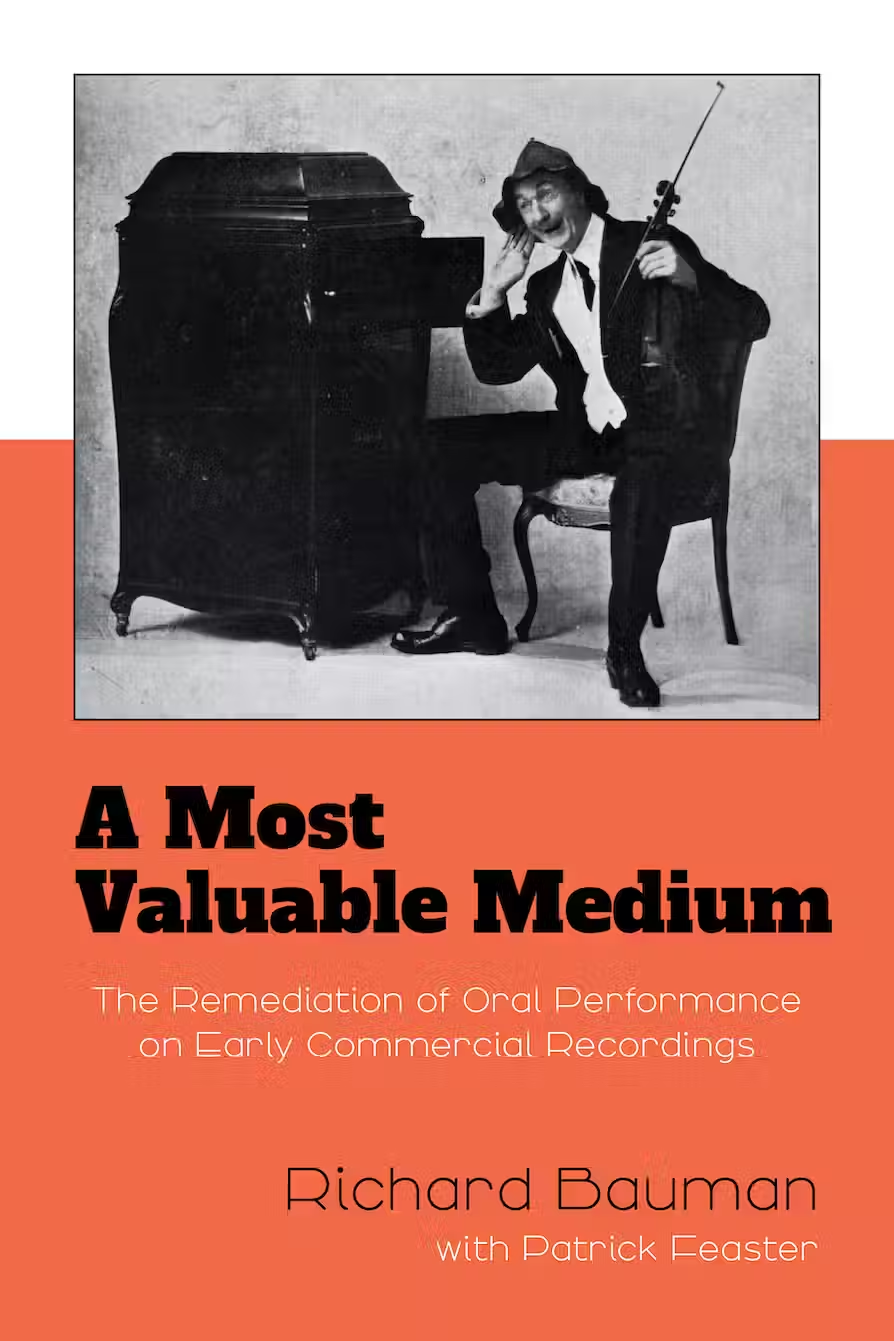
Ilana Gershon: What inspired you to study early commercial sound recordings? And what problems did these recordings present to their makers?
Dick Bauman: In hindsight, my turn to early commercial recordings seems almost overdetermined. First, the work of Milman Parry and Albert Lord on oral-formulaic composition had a profound effect on my thinking about oral poetics and performance, which have been close to the center of my scholarly interests throughout my career, from graduate school on down. A key aspect of Parry and Lord’s work focused on what happens to oral poetics with the advent of writing and print, a problem, after all, in remediation. Then, in the ‘80s and ‘90s, there was an opening among linguistic anthropologists to related debates concerning the correlates and effects of writing and print on verbal expression, stimulated by the work of Walter Ong, Jack Goody, Elizabeth Eisenstein, et al., and by further extension to the relationships between print culture and digital media. The term, “remediation,” of course, was coined by scholars interested in the advent of digital media. All of these issues, I should add, resonated with the strong turn toward contextualization and recontextualization that lay at the center of my work at the time with Charles Briggs and with colleagues in various working groups at the Center for Transcultural Studies.
In the late ‘90s, my involvement in the formation of the department of Communication and Culture at IU, which brought me into intellectually energizing dialogue with colleagues in media studies and public culture, led me to an interest in the advent of new media more generally and the dynamics of remediation as established expressive forms were adapted to the affordances of new communicative technologies. At around that same point, by a stroke of good fortune, Patrick Feaster appeared in a graduate class I was teaching on performance. In advance of a seminar presentation he was scheduled to deliver, Patrick distributed a CD to class members containing a sampling of spoken-word performances on early commercial sound recordings from the formative period of the mid- to late 1890s. That CD just knocked me off my chair. I realized that the performers were engaged in a formative moment in the development of a new medium, trying to devise ways of accomplishing the performance of genres that people were accustomed to experiencing in co-present, multi-sensory situations—stories, political oratory, sermons, market cries–employing technological means that relied on sound alone and allowed two and a half to four minutes to get the performance done. Moreover, sound recording separated the time and place of performance from the time and place of reception and shifted the site of performance from public to domestic space. How did they pull it off? That’s what the book is about.
Ilana Gershon: In the first chapter, you offer readers a way to distinguish between different types of publics that I personally find enormously helpful for thinking about the various forms of public address I happen to study –gathered publics, historically founded publics, and distributive publics.. This goes a step further than Michael Warner’s take on publics in a way that introduces techniques for engaging with differences between publics ethnographically. What would you recommend anthropologists focus on to know what kinds of publics they are analyzing?
Dick Bauman: Ever since I first encountered his work in a Center for Transcultural Studies seminar on languages and publics, I have found Warner’s work on public culture and the generation of publics energizing and provocative. In regard to chapter 2, my approach comes at the discursive constitution of publics from a perspective that is complementary to Warner’s but different in its focus and emphasis. At the risk of oversimplification, Warner is interested in the ways that publics may be constituted by the circulation of written texts, texts that are to be read. What I am concerned with in chapter two is the metapragmatics of remediation and performance, with specific reference to a particular genre, namely, political oratory. Political oratory foregrounds the rhetorical function, with a set toward the addressee. What I am trying to get at in chapter two is how, specifically, recorded forms of oratorical performance manage the addressive function, how performers interpellate receivers from whom they are removed in time and space as members of particular orders of public. Part of that problem implicates what recorded oratorical performances bring with them in the process of remediation from co-present performance to sound recording. Warner’s work, in Publics and Counterpublics (2002) takes up all of these issues to greater or lesser degrees. He notes early on that a public can be “a concrete audience” in a co-present performance, but he sets that order of public aside as outside his agenda. He also acknowledges the differential effects of genre in the discursive constitution of publics. More importantly, he attends closely to the fundamental formative importance of addressivity, at least in general. But again, we’re coming at publics from different—though complementary—perspectives. His literary perspective leads him to focus on the circulation of written texts. My interest, from the vantage point of linguistic anthropology, folklore, and media history, is on genre, performance, and remediation.
Ilana Gershon: I am struck throughout the book at the ways in which it seemed like it was an open question of the ideal life trajectory of a phonographic recording. You stress that marketers encourage collecting, and at least for some of the recordings you mention, they could easily be seen as souvenirs or items to be collected, even when they were campaign speeches, and so might seem irrelevant after an election. This is a striking contrast to how people seemed to treat newspapers – disposing the newspaper after they have served their daily or weekly purpose. Could you say more about the markets being called into being using phonographs?
Dick Bauman: Great question. When early phonograph entrepreneurs turned from marketing phonographic equipment essentially for stenographic purposes to a marketing strategy that combined the sale of relatively low-priced playback machines with the promotion of ready-made recordings as the principal source of profit, they faced the problem of defining and building markets for the phonograph of a medium of entertainment. The first effort to exploit the phonograph for entertainment purposes was to place nickel-in-the-slot phonographs in public places—arcades, train and ferry terminals, hotel lobbies, and the like. The most far-reaching marketing effort, though, was to promote the shift of phonographic entertainment from public sites to domestic space, framing sound recordings as a medium of home entertainment—in fact, the first mass-medium of home entertainment. This creative commercial process demanded the cultivation of an audience-cum-market prepared to engage performance forms that they were accustomed to experiencing in live, co-present situations now in the privacy of their own homes. These promotional efforts—specifically, how record producers and performers conceived of and aligned their records of home audiences—is one of the core problems of my book. The practical answers to that problem were many. They ranged from symbolically constructing phonograph records as prestige goods, to cultivating star performers whose records were attractive enough to create a fan base who could be encouraged to collect all of the star’s recordings, to promoting certain classes of recordings, such as presidential campaign records, as having durable value as historically important collectibles. In addition, marketers emphasized the potential of the new medium to expand audiences by including women, for example, who might not have been comfortable in attending certain kinds of live performances. Yet other efforts were devoted to proclaiming the acoustic fidelity of recordings vis-á-vis live performance. The discover and analysis of these processes make up perhaps the central problem of the book.
Ilana Gershon: Are there productive differences between aural blackface and aural class parody? I am struck by how much your chapter on country rubes resembles similar othering performances to the aural blackface and I was wondering what patterns you saw in the ways in which aural parodies were used to comment on identities that for some could be adopted and put down again.
Dick Bauman: I use the term “aural blackface” because the burlesque sermons I analyze in chapter 3 are indexical icons of sermon performances in blackface minstrelsy as a platform genre of popular entertainments. Blackface minstrel shows would have been the frame of reference through which listeners to the recordings heard the recorded performances. “Blackface,” or course, foregrounds the burnt-cork “blacking up” of the mostly white performers who made up the blackface troupes. It is a visual emblem of blackface minstrelsy. “Aural blackface” switches the sensory modality from the visual to the auditory, as befits a turn to sound recording. In larger scope, the register and style of the recorded sermons served as classic signs of difference, acoustically realized. Dialect humor—Irish, rube, German, Yiddish, African American–was extremely widespread in the popular entertainments of the period I examine in the book, ca. 1895-1920, period of burgeoning immigration to the U.S. and internal migration within the U.S. Stage dialects of all kinds were aurally performed signs of social dialects heard and marked as Other in the contemporary world of the recordings I examine. They were performance registers that indexed social types and characterological figure, both in society at large and in the domain of popular entertainment, blackface minstrelsy, early vaudeville, medicine shows, and the like.
Dick Bauman: That question requires a bit of a stretch. Let me answer by assuming that the majority of my readers will be folklorists, linguistic anthropologists, and maybe ethnomusicologists, at least open to the idea that attention to remediation and intermediality might illuminate persistent problems in their fields. After all, as I suggested in earlier answers, questions concerning orality and literacy, recontextualization, and sonic media have been around for a long time and bear on important aspects of communication in society. So, for those folks on the threshold, I have several broad suggestions to offer.
First, I would advocate for extension of remediation studies more broadly and comprehensively across media. The advent of every new medium involves remediation, yet the study of remediation in linguistic anthropology and folklore has been very selective in coverage, focusing overwhelmingly on the advent of writing and print and the development of digital media, but it’s remediation all the way down. Passing over recorded sound as a new medium, for example, as I argue in the book, gives rise to distortions and misconceptions. I should mention, though, that the still emergent field of sound studies in anthropology, energized by linguistic anthropologists and ethnomusicologists, like Steve Feld, Don Brenneis, and Ana Maria Ochoa Gautier, has opened up important new lines of inquiry and modes of analysis in the anthropological study of remediation.
Second, I would argue that the remediation of performance forms is especially revealing insofar as performance—at least as I conceive of it—is a highly reflexive mode of communication that tends to reveal especially clearly what performance forms bring with them from prior contexts and how they manage recontextualization in a new medium.
Third, I would advocate for close attention to form-function interrelationships, to genre (in its formal, thematic, and pragmatic aspects), participant roles and structures, and the dynamics of contextualization as existing forms are adapted to the affordances of new media. Here is where linguistic anthropology and ethnomusicology can lead the way.
Finally, for now, anyway, I would urge linguistic anthropologists and folklorists to cultivate the skills of media historians and to apply their own anthropological, linguistic, and folkloristic skills and toolkits to historical processes of remediation. We’ve contributed a lot to the orality-literacy debates, and I believe we have just as much to offer to the historical and ethnographic study of new media more broadly.
Robyn Taylor-Neu: It’s conventional (for this blog series) to ask about the focus and argument of the book–but Dragging seems to willfully resist reduction to a single focus or argument. So I’ll ask instead: what does this work pivot on, for you? What’s its center of gravity, so to speak?
Shaka McGlotten: For me the center of gravity is the messy struggle of making and relating—making art, doing politics, and relating to research objects, intimate others, and disciplinarily itself.
Robyn Taylor-Neu: Could you explain the background of the research and how you came to the project?
Shaka McGlotten: As I say in the book, the project began with binge viewing of RuPaul’s Drag Race. I’d never connected deeply with drag cultures, so that signaled a shift for me. I teach at a very queer school and drag, especially in its particularly quirky, out there, or monstrous iterations, played an increasingly large role in queer students’ lives. My students’ interests are always contagious. Then there was my intimate partnership with an Israeli. We’d both identified Berlin as a desirable place to live out some fantasies as creatives. So New York, where I’m based, Berlin, where we ended up for eighteen months, and Israel/Palestine, where we visited regularly became the default field sites. I think this is important to acknowledge: ethnographic field sites aren’t selected at random. We often choose them because we have some intimate connection to them.
Robyn Taylor-Neu: As you acknowledge in the preface, your book’s form is unconventional for an academic monograph–it takes shape as a non-fiction narrative comprising three kinds of writing. You mention that works by Christopher Isherwood, Leigh Patrick Fermor, and Maggie Nelson influenced the form… Could you say a bit about the affordances and challenges of this more literary approach?
Shaka McGlotten: Wow. Well, all writing is challenging, but this was sometimes excruciating. There is a formula to academic writing, and once you have it more or less down, you can follow that template pretty easily in my view. But I’d never been trained to write creative non-fiction, so it was really a lot of trial and error. In regards to these three writers in particular, I was interested in a kind of flatness I found in both Isherwood and Nelson. There’s nothing unnecessary about their prose. Fermor is a lot more florid—he helped me think more about the intersections of memoir and travel-writing. I’m not sure I’ve fully answered the question about affordances and challenges, though. So let me give it another go. One affordance is that I didn’t feel it necessary to always cover my theoretical ass, so to speak. Not everything had to be neatly tied up in an academic argument because the book is meant to create a series of associations and resonances that collectively affect the reader (as in fiction or creative non-fiction). The challenges—like I said, excruciating! I had to write and rewrite chapters to make sure that various threads (about the drag scenes, my intimate life, or pedagogy) came together.
Robyn Taylor-Neu:You’re reflexive about the process by which the research and book came to be, and you explicitly offer the book as “training for all of us to risky, vulnerable openness”… I’m curious about who you mean by “us” (that is, anthropologists, social scientists, humans?) and how you would differentiate “training” and “disciplining,” since you also mention the need to “become undisciplined” (citing Christina Sharpe, Saidiya Hartman, and Sylvia Wynter). (I should put my cards on the table here. As a PhD candidate, I’m muddling through what it means to be credible as an ethnographer and anthropologist while preserving space for genuine curiosity… when so much of the professional side of things seems like an elaborate performance of disciplinary competence.)
Shaka McGlotten: Your parenthetical hits the nail on the head. I was weaned on critical theory, and I love the possibilities for thinking that reading it provided for me. But what I don’t like is the, as you say, “elaborate performance of disciplinary competence.” I think of this sometimes as “rehearsal” too. Yes, most of us have read X, Y, Z theorists, so increasingly, when reading academic material, I think “just get to it! Get to your point!” Imagine what would happen if people cut out all of the rehearsal—books would be shorter. Now, I say all of this, but then I find books like Ana-Maurine Lara’s Queer Freedom: Black Sovereignty so beautiful—it’s a poetic work of theory in the style of something like Anzalduá’s Borderlands/La Frontera. When I think about training in risky openness/becoming undisciplined, I’m after a loosening of the reigns. I think we can still be credible and disciplined while also being open to other genres that afford us different possibilities as writers and makers, as well as the kinds of people who might engage with our work.
Robyn Taylor-Neu: Your engagements with theory are often oblique and emerge either in fragments or in the interview transcripts that you incorporate. You say that you’re not particularly invested in using theory to make claims and so forth, but could you elaborate on how you see theory and what it does for you in this work?
Shaka McGlotten: Hmmmm, I think that my previous answer gets at this somewhat. I’ve done something similar in a lot of my work. I read theory but I start with the curiosity induced by objects, or the trouble that objects pose for me. I think in terms of events, scenes, and cases as any reader of my work will note. In this way, I was very much inspired by people like Lauren Berlant and my mentor Katie Stewart. I don’t approach my writing with a theoretical apparatus in mind that I then apply to my research. Instead, the process is much more iterative, where I am trying to come to some kind of understanding informed by theory. My friend Neville Hoad calls me “ill-disciplined”! I use what I think is helpful from bodies of critical theory and then sort of move on. At least, that’s been my process in recent years, when I feel I have less to prove.
Robyn Taylor-Neu:My impression is that many of your interlocutors, as artists and activists, are versed in (or at least passingly familiar with) the writings/works that seem to shape your own thinking about the politics of drag… is this the case and, if so, how did that affect your approach in interviews?
Shaka McGlotten: Yes! The folks I worked with were the real experts: The Drag and Liad in particular had sophisticated understandings of queer theory, art, and politics, so these were conversations informed by shared archives. Still, we didn’t always share understandings of who was included under the rubric of drag. For example, Natali Vaxberg didn’t initially understand why I wanted to talk to her, but over the course of our discussions, she increasingly embraced the associations.
Yun Chen: Recovering Histories is an ethnography of the entanglements between individuals’ lived experiences of recovering from heroin addiction and their collective narratives of reimagining laboring lives in a rapidly changing social world in post-Mao Southwestern China. You talked a little bit about how you got involved in conducting research on this topic in Gejiu in the first chapter of the book. What interested me a lot was that you initially entered this field as someone working for international NGOs carrying out HIV/AIDS prevention harm reduction projects within the public health or global health contexts. Nevertheless, instead of writing a book on heroin addiction or recovery with a focus on these institutions or interventions, you chose to really attend to the everyday lived experiences and narratives of the group of individuals with heroin-use histories with a phenomenological orientation. Could you tell us a little bit about how did you come to study heroin recovery from this angle, in what ways did your public health training/working experiences influence your approach to this topic, and what was your main goals to research on heroin/recovery/China as an anthropologist?
Nick Bartlett:. Sure! I first encountered heroin addiction discussed as a problem in China in 2002. I was working on HIV prevention projects as part of the social marketing implementer of the China-UK project at the time. While we were funding programs in Yunnan and Sichuan provinces, that year I spent a lot more time in our Beijing headquarters than I did interacting with the people who were directly impacted by HIV. I think part of why I initially became interested in this population in China was due to the absence of people with drug use history from public health conferences and meetings I was attending. CDC officials generally spoke on behalf of this group. It wasn’t surprising given the stigma that people with drug use history faced in China, but left me with a lot of questions about the lives of the people identified as part of this “high risk population.”
In the mid-2000s I got more directly involved in NIDA-funded studies of heroin use in China, and later started working for the Open Society Foundation’s International Harm Reduction Development program. Working at a foundation where one of our primary mandates was to support people with drug use history to organize and advocate for their own needs was an important opportunity for me. Questionnaire-based public health research had allowed me to meet a number of people with heroin use history in different provinces, but the interviews I was doing started to feel stale and narrow in scope; I wanted to build relationships that were more open-ended and enduring. The role I had at OSF allowed me to work closely with compelling people doing amazing work.
After my third year of grad school, I moved to Gejiu, where a number of grantees were based, leaving my part-time position at the foundation. Many of the people I met in Gejiu had been recently released from compulsory detox centers and were absorbed by the task of attempting to realize a “life after drugs.” I became interested in a new set of questions: Where does the work of recovery happen exactly? How is it experienced, specifically in relation to lived experiences of individual and collective time? These were questions that didn’t seem to be asked in other contexts, but they seemed vital to trying to understand what recovery meant in this time for this group.
Yun Chen: One thing that I really appreciated about your book was that you effectively showed the readers, against a common way of talking about heroin addiction, that your interlocutors’ broader lived experiences of laboring, family life, socioeconomic shifts fundamentally shaped the ways they understood their lives under the influence of heroin as well as what would be a life after heroin. In other words, you decentered the role of the drug itself in defining the experiences of this generational group, and repositioned them within the sociohistorical contexts that they shared with their non-user contemporaries. By doing this, rather than being a prerequisite for making sense of their lives, the use of heroin became a particular condition that in various ways constrained and enabled their experiences of the world. It was a condition among many other conditions which needed to be examined through the shared histories of the collective “we.” I was wondering that when you wrote with this perspective, have you had concerns about downplaying the specific (bodily, sociocultural, political) experiences of heroin addiction and recovery that were potentially distinguished from other forms of marginality? If so, how did you balance between not essentializing people with histories of heroin use/recovery and attending to the unique experiences of this specific group in your analysis and writing?
Nick Bartlett: Great questions! I guess there are a couple points I should make in trying to answer them. First, the move to decenter the role of the drug as you put it wasn’t initially a conscious decision on my part. As I spent time with people who were committed to various projects of recovery, I became aware that even people who I knew were actively using didn’t use in my presence and rarely brought up their heroin use in our conversations. I certainly could have tried to make heroin use a more central part of the research, either by being present when people were using, or through more detailed explorations of the direct effects use of the drug had on this group’s lives. My decision not to do this perhaps says something about my commitments, and theirs, during my fieldwork. At the time, even if the absence of a certain type of attention to heroin use was a form of collusion, I felt I was learning an enormous amount from participating in other aspects of their lives, that the direction my fieldwork was taking in was allowing me to understand recent history of Gejiu—even China—in new ways.
The move to decenter the drug could be understood as pushing against the constant ways that heroin users have been represented in Chinese media. So much of people with heroin use history’s identities in China were defined by their status as “registered drug users” by the public security apparatus, “injecting drug users” by public health workers, or just “addicts” by the public. I can still remember the cookie-cutter news stories that would come out about heroin users every year on 6/26, International Day against Drug Abuse. But the reality was, many of the people I came to know, despite having been connected to heroin for over 20 years, actually hadn’t spent all that much time using heroin. Or they had used heavily early in their adult lives and then spent much of decade before I knew them bouncing in and out of state compulsory labor centers and periods of unemployment living with family members and receiving treatment at methadone clinics, where use of heroin was relatively rare. I was encountering particular sort of paradox: there wasn’t much heroin in Gejiu during my research, but there were a considerable number of so-called “heroin addicts.” In addition, members of this group were often eager to argue that they were in the process of becoming (or, in some cases, returning to) existing as a different type of person, that “drug user” or “addict” were never terms that accurately depicted who they were.
This leads us to the problem of the collective “we” that you brought up. As I was writing the book, I couldn’t escape thinking about the figures I came to know as being linked by a strong generational identity. Virtually all of the users I met were born between 1965 and 1980 and encountered the drug in the late 1980s and 1990s when heroin first began circulating in large quantities.. With time, I came to see that members of this generational cohort shared the challenges feeling they were becoming obsolescent economic actors quickly disappearing from the country’s history, and saw how recovery as intimately linked to navigating an economy that looked quick different from the one that they had entered as teenagers. In Chapter One, I argue that the figures in the group are part of what might be considered a Mannheimian generational cohort, sharing an orienting set of dramas in their youth and enduring common discursive landscape of historical problems and social imaginary and the horizon of the future. Against this common background, each of the book’s final chapters turns to a different way that an individual or small group of people with heroin use history came to answer and live the challenge of “returning to society” as they understood it. Inevitably, these later chapters grapple with evocations of “we” that take different forms; some of my interlocuters emphasized belonging to a broader community of displaced workers, others spoke of their connection to a vanguard group of grassroots civil society actors, still others as part of a cohort of unemployed idlers who had been deprived of previously existing government care. Sometimes these connections give the individuals I write about hope in achieving a “return”; for others, the collective identity they evoke is experienced as immutable and suffocating. I try to show how these fragile and shifting senses of collective life can be understood as communities of time that are linked in complicated ways with narratives and sensations of living within a broader trajectory of Chinese history.
Yun Chen: “Recovery” is another keyword appeared throughout this book. The narratives you laid out in those chapters really demonstrated the complex ways in which “recovery” was imagined, embodied, lived, and/or contested by your interlocutors. From recovering-without-hope to recovering-through-laboring, these narratives challenged existing conceptual accounts of recovery in anthropological and health literatures. In your ethnographic encounters, “recovering” was intricately linked to the idea of “returning (huigui shehui),” which in my view metaphorically presumed a status of normalcy from which one temporally diverged and was expected to get back to. Complications arose, in this case, when the status of “being normal” itself was constantly on-the-move with the flow of the rapidly changing social world. Those in recovery were thus expected (or demanded) to “return” without any clear path or anchor point. Or in other words, their labors of return seemed to have no reachable destinations. Then what might be the actions of “returning” really for when there was no place to return to? Could you elaborate more on your understandings of “returning” in this case, and what insights it might bring to future anthropological studies of addiction and recovery?
Nick Bartlett: I think that the way you formulated your understanding of “returning” in relation to “recovery” nicely articulates a key intervention that I was trying to make. As I was writing the book, I found a distinction between two Chinese terms—jiedu and huigui shehui —helpful in heightening a broader tension around the stakes of recovery. Jiedu was about the accumulation of clean time, a quantitative, empty time that could be easily measured and compared. Here, the prescribed goal of recovery isn’t a type of experience or way of living but simply the absence of the traces of an ingested substance that made you do something else. Huigui shehui, another term that could be translated as a form of “recovery” frequently brought up in China when discussing drug users but also many other vulnerable populations, emphasizes the action of moving to a previously existing state of affairs. But what is the “normal” that is presumed to exist in this collective? Especially in Gejiu, were the fabric of daily life had been changed so dramatically with the disassembling of state work units and rapid expansion of private sector, which understanding of collective life and economic roles were members of this group to attempt to achieve? While some had very clearly defined goals of what huigui meant, others claimed that huigui was impossible, or even that huigui was not a helpful way to think about recovery. I found the slogan a useful starting point to think about lived experiences of time located between the individual and shifting understandings of collective life.
Yun Chen: To account for how people with heroin use history connected their understandings of their own past, present, and future to the collective shared experiences of China’s rapidly changing society, you laid out three approaches to historicity which effectively demonstrated that there was not an overarching framework for experiences of time. Such an attempt to connect the phenomenological lived time with the historical shared time was achieved through your emphasis on narratives and narrative structure. Can you further unpack the conceptual connections between narrative and historicity as demonstrated by your ethnographic encounters, maybe in dialogue with Mattingly’s “narrative emplotment” (1998) or Carr’s “doubly practical narrative structuring” (1998)? I was also wondering, in your view, that to what extent and in what ways may this conceptual emphasis on narrative and historicity be applicable to medical anthropology topics other than addiction/recovery?
Nick Bartlett: Some people tend to be energized by how their fieldwork can facilitate making an intervention into particular conversations. I have been more motivated by trying to figure out how to write the book as a whole, how to interpret recovery as a lived experience and then connect the recovering histories that would take the reader through a particular progression. So instead of trying to articulate “this is my position on narrative or phenomenology,” I found myself returning to authors who could help me make sense of a particular dynamic that I was struggling to understand in from my relationship with the people in the book. Writings by Sara Ahmed, David Carr, Paul Ricoeur, Pierre Bourdieu and others were very helpful in attending to quite specific questions or problems that I was trying to work through based on fieldwork encounters.
I can say a bit more about Cheryl Mattingly’s narrative emplotment, since you brought it up. In her work, narrative tends to be connected to preserving hope in the face of uncertainty and pain, often in response to a grim medical diagnosis. But I was interested in exploring what seemed to be an inverted dynamic occurring in my own fieldwork. For a small number of people I came to know, the narrative that they came to repeat and lived seemed to shut down the possibility of a future different from the present, giving a finality to a story of their stories about the “dying out” associated with a broader cohort of heroin users and, by extension, their own premature obsolescence. I found Mattingly, Carr and others helped me to think about the potential devastating power narrative could have on individuals and groups.
One challenge for me was how to make the particular recovering histories presented in the individual chapters have their own internal coherence while contributing to the broader themes of the book. Given the different ways anthropologists, postcolonial scholars, and philosophers have come to take up the term, historicity had this elasticity to it that seemed to encompass and help organize the interventions I made in the book.
As for the potential relevance for narrative and historicity for medical anthropology, these are areas where others have done incredibly thoughtful work; I would leave it to the reader to say if the book’s approach resonates with their research or experiences. I will say I have a real fear of allowing concepts to become too rigid in my interpretations. It is so easy to lose the complexity of what happens in fieldwork encounters As I finished writing, it was quite important for me to figure out a way to allow some of the neatness of previous chapters to unravel. Examining my relationship with a close friend and collaborator where I really didn’t have a sense that I could comfortable say what his “return” related experiences were gave me the chance to question some of the way the book was structured.
Yun Chen: You talked about your 2018 visit to Gejiu in the Epilogue. I’m curious that, given the rapid changes happened to your fieldsite in these recent years, to what extent or in what ways (if at all) would you shift your focuses and/or the ways in which you approached the topic?
Nick Bartlett: It’s been difficult to not be able to go back these last years; I was hoping to be based in Yunnan this past year but wasn’t able to get visas for my family. I think in some ways I was lucky to be there in the 2000s and early 2010s. Already during that 2018 trip, there was this sense that certain kinds of collaborations that were possible earlier could no longer happen. I have felt a lot of sadness about that.
I could imagine writing more about shifting understandings of labor within the context of ongoing changes to how Gejiu city and nearby mountainside communities relate in what is an increasinglypost-mining moment for the region. I’ve also been doing some online interviews and going through archival sources to learn more about what was happening on the mountains in the Deng era as part of a special issue I am co-editing exploring the specific energies and legacies of 1980s in China. So to answer your question, I think today I would spend more time in mountainside communities trying to make sense of workers’ experiences of the current moment.
Alana Mazur: One of the main themes running through your book is Indigenous audiovisual media and mediatized politics. You provide an in-depth and nuanced analysis of the role of videography in connecting the Ayuujk hometown community in Tamazulapam and satellite communities in Mexico and in the United States. Could you please situate the focus and the main arguments of your research?
Ingrid Kummels: The protagonists of my book who live in Tamazulapam, Oaxaca, and Los Angeles, California, may be characterized as pioneers of media practices battling remoteness. When I set out to do my research in 2012, my intent was to explore the local media histories shaped by the Ayuujk people of the Mixe Region in Oaxaca, Mexico, and give them greater visibility. I had become aware of their autonomous endeavors concerning photography, radio, TV, and video adapted to their own language and “ways of seeing” (Berger) when in 1993 (together with Manfred Schäfer) I filmed what was perhaps the first local TV station (TV Tamix) set up autonomously in a Mexican Indigenous village, precisely in Tamazulapam del Espíritu Santo. Before that, individual villagers had engaged in sophisticated single-lens photography and radio broadcasting, which they adapted to community needs. This motivated me to revisit Tamazulapam almost 20 years later, in 2012, and update these developments from the perspective of media anthropology. But when I returned to Tama (as the village is nicknamed), I realized how pervasive migration for higher education and job opportunities had become—mainly to the United States because of the possibility of earning up to ten times more than in Mexico. At the same time, this entails immobilization since migrants are forced to cross the border without authorization. b—and above all fiestas, large community celebrations in honor of the patron saint.
When observing and talking about village media practices it became obvious that culturally specific genres had been created such as fiesta, family rite-of-passage, and officeholder videos; these had not received much scholarly attention since they are at the intersection of politics, entertainment, and culture. Means of communications had been harnessed to facilitate community life and communal values even from afar, ranging from interpersonal cell phone calls to a veritable transnational video industry whose offerings included series of ten fiesta DVDs, which were ubiquitous not only at local markets, but also in Oaxaca City and in U.S. cities like Los Angeles. Ayuujk people had set up their own infrastructure and used mass media for practicing community politics. Migrants living in Los Angeles invested in their production in order to participate in the home village’s modernization, receive recognition as village members, and serve as political officials in the hometown. These media activities therefore contribute to political ideas about Indigenous autonomy, which is called Comunalidad in Oaxaca. Here it is important to emphasize how these practices challenge the way that Indigeneity has been constructed “from above” and as an antithesis to the modernity that media (often equated solely with mass media) allegedly embody. On the other hand, the use of media and the innovations devised by Indigenous peoples that combine storytelling, crafts, music and dance with analog and digital mass media often are not recognized as self-determined, cutting-edge developments. Nevertheless, these innovations have been achieved despite extremely adverse media structures in Mexico, where private mega media conglomerates dominate radio and TV, while alternative media are pushed into informality, against a “visual divide.”
Here is where the concept of media spaces comes in. Indigenous media makers open such spaces in multiple inventive ways when overcoming the uneven access to mass media due to racialized inequality, which is inscribed not only in the representations of Indigenous peoples but also in the contexts in which they received media training and engaged as practitioners. These are spaces that actors have been able to extend in terms of geography, practice, and imagination. Setting up their own media infrastructure, appropriating media knowledge and technology according to “one’s own” standards of professionalism, and managing transnational diffusion and marketing all form part of this endeavor.
Alana Mazur: In the introduction you mention that your ethnographic research was multi-sited and the fieldwork was conducted in Tama and Los Angeles between 2012 and 2016. What motivated you to pursue this ethnographic participatory research with Indigenous media makers in Mexico? How was this experience like for you?
Ingrid Kummels: I am a practitioner of media myself and after studying anthropology I started working as a professional filmmaker making documentaries for German TV. So, I know what it’s like to engage in filming, interact with people while doing it, and critically reflect on this work and issues of representation. I like to exchange ideas with people who have had similar experiences. To give an example: When I first met a fiesta filmmaker, I was fascinated to see that he had installed his entire store and production unit with editing equipment in his pickup: along with his son, he not only edited the films on DVD discs overnight, but also printed covers so that the next morning they could start selling DVDs to visitors during the five-day patron saint celebrations. He readily told me about arguments that can arise when “illicit” dance pairs were spotted on village videos; they had to do with transnational marriage and family life. The recording of sacred places and rituals that normally are not allowed to be viewed was considered an audiovisual transgression related to the special value attached to place and being on-site in times of deterritorialization. Women face particular challenges as both mediamakers and comuneras. These self-determined media activities therefore paved the way for negotiating novel visions of community life, gender, and Indigeneity in the twenty-first century. (See my portrayal of their work in “Ayuujk Cameras,” https://vimeo.com/293855233.)
Following these itinerant merchants during the month of May 2013 meant getting to know how they cultivate networks and forge alliances in many villages of the Sierra Mixe and beyond; some have more to do with commercial circuits, others with political solidarity. Mediamakers
are well informed on the different situations and aesthetic tastes of specific village audiences in their respective transnational outreach. As a result of specific migratory pathways taken, community celebrations in the home villages are pervaded by forms of transnational reciprocity. To compensate for their absence and their lack of participation in the village’s governance system called Usos y costumbres, migrants contribute with financial donations to hometown fiestas. Their sponsorships are announced publicly and above all documented in fiesta videos, which a transnational audience witnesses. These viewers participating from a distance are constantly in the mind of videographers and influence their choice of motifs, scenes, and camera settings. I moved along these networks, since mediamakers would orient me and introduce me to their colleagues and advisors. It was often through these contacts that I got to know a village for the first time, so I was immediately immersed in mediamaking there. On the spur of the moment, I would be invited to an event they were covering. While this work was delightful, I also learned about their strict professional discipline and soon was very conscious that there are no simple onlookers at a fiesta: community members have a moral obligation to participate which includes its sacralized dimension. So, in many ways, recording a fiesta is a solemn affair based on these same moral obligations.
Alana Mazur: The book provides a captivating analysis of the sociopolitical dynamics that involve diasporic movements among the Tama inhabitants across the Mexico-US border. Along the chapters, you elucidate, for instance, how remittances sent by migrant villagers to their families and “unpolitical fiesta videos” ostensibly sustain vibrant connections between the local “comunitario” and the growing “transnational village” (p.35). Through mediatization, as you conceptualize it, videographers both capture and create myriad of “media spaces” (p.391).
In this vein, could you provide a brief overview of these concepts and the processes they entail? What implications does the diffusion of Tama mediamakers’ work have on the Ayuujk ja’ay community members’ social life? Following on from that, how does Ayuujk videography constitute itself as “self-determined media,” as you suggest in the introduction (p.400)?
Ingrid Kummels:In short, transnationalism as a single field of social relations between two or more nation states due to the regular flow of people, commodities, money, and ideas across the borders is communalized by Ayuujk people. Migration, even in the many cases in which it is motivated by individual, personal interests, becomes at some stage a communal joint venture—in the more literal sense. Transnationalism scholarship has looked into the communal logics on which migration is based, but has often emphasized material, financial transfers. Nevertheless, transnational community building depends on the desire, the urge to be involved with a community. This is where self-determined media come into the picture.
As I examined the scholarship, I became aware of how transnationalism forgoes a perspective on media. On the other hand, media anthropology tended to view Video Indígena within the national container of Mexico. But in fact, the political Indigenous movement and the use of media to overcome distance in the transnational context, which includes connecting with the cross-border community in an entertaining way, are interrelated. The focus of my research is situating media use both within the contested field of Indigeneity as well as identifying it as an indispensable glue of transnationalism. There is nothing natural or matter-of-fact about maintaining a connection with one’s community of origin. In the case of Tama, reliance on self-developed media practices is key to new social arrangements between the hometown and the satellite communities that allow them to continue their communal way of life despite the restrictive border. These arrangements systematically integrate the migrating population. Many individuals participate in this endeavor due to a communal spirit. So, it is important to explore these communitarian values, Comunalidad or simply “lo communal,” as most people refer to it. It upholds the logic of owing service to a community, which at the same time is a sacralized entity worshiped in the patron saint. All of this is reflected in fiesta films and is understood by people with similar experiences who are socialized in this “way of seeing.”
Self-determined media practices are key for the creation of community connected to similar values. The hometown is one of its main motifs, since the future aspired to is projected onto this special place. Videographers are comuneros and comuneras, that is, they perform duties that influence their media practices and products. Despite being merchants and commercializing DVDs in a transnational outreach, they must also conduct themselves in a way that accommodates the values of community life (for example, not charging too much and paying the community a fee for filming); it is expected that their work portray those communal values. Moreover, they themselves have to invest in the community when needed. On the whole, they are an essential part of the transnational communal tissue.